

If your eyes often make you look tired even after you’ve had a good night’s sleep, you may have wondered whether something can actually be done about it. Dark circles, hollowness beneath the eyes, and a shadowed appearance can be frustrating because concealer may only cover the problem temporarily. For some people, the underlying issue is not simply skin discoloration. It may be a loss of volume in the area beneath the eyes.
That’s where under eye fillers may come into the conversation.
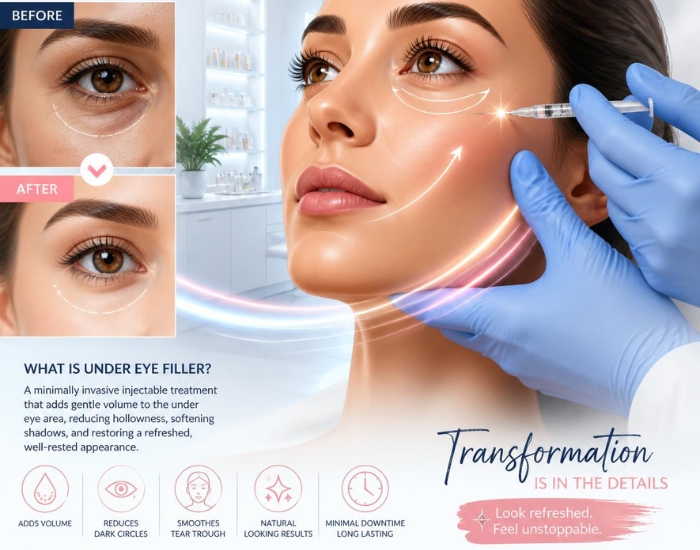
Under eye filler, sometimes called tear trough filler, is an injectable treatment intended to improve the appearance of hollowness in carefully selected patients. It can soften the transition between the lower eyelid and cheek and may reduce shadows that contribute to a tired-looking appearance. However, it is not appropriate for every type of dark circle or under-eye concern.
That distinction matters. The skin beneath the eyes is thin and the anatomy is complex. Puffiness, pigmentation, visible blood vessels, skin laxity, allergies, genetics, and facial structure can all contribute to the way the under-eye area looks. Simply adding filler does not correct every one of these causes.
So if you’re considering tear trough filler, the most important question isn’t simply whether the treatment works. It’s whether your particular under-eye concern is actually caused by something filler can improve.
Table of Contents
- Do Under Eye Fillers Really Work?
- What Are Under Eye Fillers?
- What Is a Tear Trough?
- Who May Be a Good Candidate for Under Eye Filler?
- What Are the Benefits of Under Eye Fillers?
- Can Under Eye Fillers Get Rid of Dark Circles?
- What Do Under Eye Filler Results Look Like?
- What Are the Risks of Under Eye Fillers?
- What Is Recovery Like?
- Under Eye Fillers in Katy, TX
- Frequently Asked Questions
- Medical Disclaimer
Important Note
The area beneath your eyes can say a lot about how you feel about your appearance, especially when you constantly look tired despite feeling fine. But dark circles and hollowness do not all have the same cause. Understanding whether your concern comes from volume loss, pigmentation, shadows, puffiness, or another factor can help you avoid choosing a treatment that isn’t designed for the problem you’re actually trying to solve.
Do Under Eye Fillers Really Work?
Under eye fillers can improve the appearance of hollowness and shadows beneath the eyes in carefully selected patients, particularly when volume loss in the tear trough area contributes to the tired-looking appearance.
The key phrase is carefully selected patients.
Under-eye filler is not a universal treatment for dark circles. If the primary problem is pigmentation, prominent blood vessels, significant puffiness, or loose skin, filler may not provide the improvement you’re expecting.
When volume deficiency is the main contributor, a hyaluronic acid-based filler may be used to soften the hollow transition between the lower eyelid and cheek. By reducing the depth of the depression, the treatment may also reduce the shadows that make the area appear darker.
The goal should be subtle improvement rather than creating a completely different appearance. Because the skin around the eyes is thin and delicate, using too much product can create problems rather than solving them.
This is one reason why under-eye injections require careful anatomical assessment and an experienced medical injector.
What Are Under Eye Fillers?
Under eye fillers are injectable products used to address certain forms of volume loss or contour irregularity beneath the eyes. In appropriate patients, the treatment can restore some of the volume that has been lost over time and create a smoother transition between the lower eyelid and upper cheek.
Many fillers used in facial aesthetics are made with hyaluronic acid, a substance naturally found in the body. Hyaluronic acid has water-binding properties, and different formulations are designed to have different characteristics depending on the area being treated.
However, not every hyaluronic acid filler is appropriate for the under-eye area. The product needs to be selected carefully based on the anatomy, skin characteristics, desired correction, and provider experience.
The treatment itself involves placing a small amount of filler in specific tissue planes beneath the eye. The precise technique depends on the patient’s anatomy and the provider’s assessment.
Because this is such a delicate area, more filler is not necessarily better. A conservative approach is often important when the goal is to maintain a natural appearance.
What Is a Tear Trough?
The tear trough is the natural depression that runs from the inner corner of the lower eyelid toward the cheek. For some people, this contour is barely noticeable. For others, it becomes more pronounced with age or is naturally visible because of genetics and facial anatomy.
As facial volume changes over time, the transition between the lower eyelid and cheek can become more defined. The result may be a hollow or shadowed appearance beneath the eyes.
When volume loss is contributing to this contour, a provider may consider tear trough filler as one possible treatment.
But it is important to understand that the tear trough is not simply an empty space that needs to be filled. It is part of a complex three-dimensional area containing delicate structures, blood vessels, nerves, fat compartments, and thin skin.
That complexity is why an experienced provider should assess the entire lower eyelid and cheek area rather than treating the hollow in isolation.
Why Do Under Eyes Become Hollow?
Under-eye hollowness can have several causes, and they can occur at the same time.
Natural facial anatomy is one possibility. Some people have prominent tear troughs from a young age because of their genetics and bone structure.
Age-related volume changes can also contribute. As we get older, changes in facial fat compartments, collagen, skin elasticity, and underlying structures can alter the relationship between the eyelid and cheek.
Skin thinning can make existing shadows or blood vessels more noticeable. Because the skin around the eyes is naturally thin, changes in its thickness and elasticity can have a visible effect.
Fat distribution and puffiness can also change the appearance. Interestingly, someone can have both puffiness and a hollow transition at the same time. In that situation, simply adding filler may not be the right approach.
This is why an under-eye consultation should involve more than asking whether you have “dark circles.”
Who May Be a Good Candidate for Under Eye Filler?
The best candidates are generally people whose primary concern involves an appropriate form of volume deficiency or contour change that can reasonably be addressed with filler.
A consultation may be appropriate if you notice that the area beneath your eyes looks hollow, sunken, or shadowed and you believe this contributes to a tired appearance.
However, having dark circles does not automatically make someone a candidate.
A provider should consider your skin quality, degree of hollowness, presence of bags or swelling, pigmentation, facial anatomy, medical history, previous treatments, and expectations.
It is also important to have realistic goals. Under-eye filler may soften a hollow or reduce the appearance of shadows, but it cannot completely remove every sign of aging or guarantee that dark circles will disappear.
People who expect a subtle improvement may be better positioned for a positive treatment experience than someone expecting the procedure to completely transform the under-eye area.
Who May Not Be a Good Candidate?
Under-eye filler may not be the best choice when the main concern is significant under-eye puffiness, prominent bags, excess skin, or pigmentation rather than volume loss.
For example, if the lower eyelid already has substantial fullness, adding more volume may make the area appear heavier instead of smoother.
Likewise, if the darkness is primarily caused by pigmentation, filler may not address the underlying cause. A provider may recommend a different skincare or aesthetic approach depending on the reason for the discoloration.
Active skin infections or certain medical conditions may also require treatment or evaluation before cosmetic injections are considered.
The goal of a consultation is therefore not simply to confirm that you can receive filler. It is to determine whether filler makes sense at all.

What Are the Benefits of Under Eye Fillers?
When appropriately selected and performed, under-eye filler can provide several aesthetic benefits.
It May Reduce the Appearance of Hollowness
The most direct benefit is improvement in a sunken or hollow appearance caused by volume deficiency. Carefully placed filler can soften the depression and create a smoother transition between the lower eyelid and cheek.
It May Reduce Shadows
Not all dark circles are caused by pigmentation. Sometimes the area looks darker because a hollow creates a shadow. Reducing the depth of that hollow may reduce the shadow and make the area look brighter.
It Can Create a Smoother Facial Transition
The lower eyelid and cheek should ideally transition naturally. When the contour becomes more pronounced, the face can appear more tired. Appropriate treatment may soften that transition without creating obvious volume.
It Can Provide a Refreshed Appearance
Some patients are not trying to look dramatically different. They simply want to look less tired or worn out. When the underlying concern is appropriate for filler, subtle correction may provide a refreshed appearance while preserving the patient’s natural facial features.
Can Under Eye Fillers Get Rid of Dark Circles?
Not necessarily. Under eye fillers can help when dark circles are partly caused by hollowness and shadows, but they do not treat every cause of under-eye darkness.
This is one of the most important things to understand before treatment.
Dark circles may be related to pigmentation, genetics, thin skin, visible blood vessels, allergies, rubbing or irritation, structural shadows, or volume changes. A person can even have several of these factors at the same time.
| Under-Eye Concern | May Filler Help? | Why |
|---|---|---|
| Hollow tear trough | Potentially | Filler may restore volume and soften the contour. |
| Shadow caused by hollowness | Potentially | Reducing the hollow may reduce the associated shadow. |
| Pigmentation | Usually not directly | Pigment requires a different treatment approach. |
| Significant under-eye bags | Not necessarily | Adding volume may not correct excess fullness. |
| Loose skin | Limited | Filler does not remove excess skin. |
This is why a skilled evaluation matters. If your main concern is pigmentation rather than volume loss, your provider may recommend a completely different approach.
What Do Under Eye Filler Results Look Like?
The goal of under eye filler is usually subtle correction rather than a dramatic change. When the treatment is appropriate and conservatively performed, the area may look smoother, less hollow, and less shadowed.
Many patients are not looking for people to notice that they’ve had a cosmetic treatment. They simply want to hear, “You look rested,” rather than, “What did you have done?” That is a useful way to think about the goal of tear trough filler.
Immediately after an injection, however, the treated area may look different from the eventual result. Temporary swelling, redness, tenderness, or bruising can occur. Because the skin around the eyes is thin, even a small amount of swelling may be noticeable.
It is therefore important not to judge the final result immediately after treatment. Your provider can explain the expected settling period and when it makes sense to evaluate the outcome.
How Natural Should Under Eye Filler Look?
A natural result should preserve the normal shape and movement of the face while reducing the specific concern being treated.
The under-eye area should not look excessively swollen, unusually firm, or disconnected from the cheek. This is particularly important because the skin in this region is thin and can reveal irregularities more easily than other areas of the face.
A conservative treatment philosophy can help avoid the temptation to fill every visible depression. In some cases, accepting a small amount of natural contour is preferable to adding too much product.
How Long Do Under Eye Fillers Last?
The longevity of under eye filler varies from person to person and depends on the product used, amount injected, individual metabolism, treatment technique, and the characteristics of the treatment area.
Hyaluronic acid fillers are not permanent. Over time, the body gradually breaks down the product, and the treated area may slowly return toward its previous appearance.
Some patients may maintain improvement for many months, while others may notice changes sooner or later. Because the under-eye area is different from areas such as the lips or cheeks, your provider should discuss expected longevity based on the specific product and treatment plan.
It is also worth remembering that longevity is not the only measure of a successful treatment. A filler that lasts a long time is not necessarily the best choice if it is inappropriate for your anatomy or produces a result you do not like.
What Happens During an Under Eye Filler Appointment?
The appointment generally begins with a consultation rather than immediately moving to injections. This is especially important for the under-eye area because the provider needs to determine whether the problem is actually related to volume loss.
Your provider may examine the lower eyelids and surrounding facial structures from different angles. They may assess the depth of the tear trough, cheek volume, skin quality, pigmentation, puffiness, and the relationship between the eyelid and cheek.
Your medical history and previous cosmetic procedures should also be reviewed.
If filler is considered appropriate, the provider will explain the product, treatment plan, expected results, potential risks, and aftercare.
The injection technique varies depending on the provider and the patient’s anatomy. Some providers use a needle, while others may use a cannula or a combination of techniques.
There is no single technique that is appropriate for every patient. The important factor is that the provider understands the anatomy and has experience treating this particularly delicate region.
Does Under Eye Filler Hurt?
Most patients describe some pressure, pinching, or temporary discomfort rather than significant pain. The exact experience varies depending on individual sensitivity and the injection technique.
Some products and treatment approaches include local anesthetic or other methods intended to make the procedure more comfortable. Your provider can explain what will be used during your appointment.
If you are nervous about needles or particularly sensitive around your eyes, mention this during the consultation. Knowing what to expect can make the appointment feel much less intimidating.
What Is Recovery Like After Under Eye Fillers?
Recovery is generally focused on allowing the treated area to settle while monitoring for expected temporary effects.
You may experience some swelling, tenderness, redness, or bruising. Since the under-eye skin is thin, bruising can sometimes be more visible than patients expect.
Your provider will give you individualized aftercare instructions. These instructions may include recommendations about physical activity, pressure on the treatment area, skincare products, and when to return for follow-up.
It is important to follow the instructions provided by the clinician who performed the treatment rather than relying on generic advice from social media.
What Should You Avoid After Under Eye Filler?
Your provider will tell you exactly what activities or products to avoid and for how long. In general, patients should avoid unnecessarily manipulating or pressing on the treated area unless specifically instructed to do so.
Do not massage the area on your own simply because you think doing so will help the filler “settle.” If you have concerns about the way the product looks or feels, contact your provider first.
Similarly, don’t schedule additional cosmetic procedures immediately without discussing them with your injector. Combining treatments without appropriate timing can make it harder to determine what is causing swelling or irritation.
What Are the Risks of Under Eye Fillers?
Like all injectable treatments, under eye fillers have potential risks. Some effects are temporary and relatively common, while other complications are uncommon but can be medically serious.
Common temporary effects can include swelling, bruising, redness, tenderness, and discomfort at the injection site.
There can also be aesthetic complications, such as asymmetry, lumps, irregularities, overcorrection, or a bluish discoloration known as a Tyndall effect when certain hyaluronic acid fillers are placed too superficially.
Because the area around the eyes contains important blood vessels and other delicate structures, rare vascular complications are a significant reason why injector experience and anatomical knowledge matter.
Patients should not choose a provider based solely on price. The experience, medical qualifications, treatment approach, and ability to recognize and manage complications are important considerations.
Important Note
It is normal to feel nervous when you read about possible complications from an injectable treatment, especially around the eyes. Most patients are not trying to take unnecessary risks—they simply want to look more rested. The best way to approach treatment is not to panic or self-diagnose, but to have an honest consultation with a qualified medical professional. Some under-eye concerns are mild and cosmetic, while others require a different type of evaluation. If something looks or feels significantly different after treatment, contact your provider rather than trying to correct it yourself.
When Should You Worry After Under Eye Filler?
Most post-treatment swelling and bruising are temporary. However, patients should know that certain symptoms require prompt medical attention.
Severe or worsening pain, significant changes in skin color, unusual blanching or discoloration, sudden vision changes, or other concerning symptoms should not be ignored.
Because serious vascular complications involving the eye are rare but potentially urgent, sudden vision problems after an injection require immediate medical evaluation.
If you experience a concerning symptom after treatment, contact your injector or seek urgent medical care according to the severity of the symptom. Do not wait for a routine follow-up appointment if you believe something is seriously wrong.
Can Under Eye Filler Make Bags Worse?
It can be a concern, particularly in patients who already have significant puffiness or fluid retention beneath the eyes.
Hyaluronic acid attracts and holds water. In an area where swelling is already present, adding additional volume may not produce the desired appearance.
This is one reason why a patient with prominent under-eye bags may need a different treatment strategy than someone whose primary concern is a deep tear trough.
A good consultation should distinguish between a hollow and a bag. They may appear next to each other, but they are not the same problem.
What If You Have Both Tear Troughs and Under-Eye Bags?
This can be one of the more challenging situations to evaluate.
Some patients have a hollow directly beside an area of fullness. If filler is placed without considering the entire contour, the result may make the transition look less natural rather than smoother.
In these situations, the provider needs to consider the relationship between the lower eyelid, tear trough, and cheek.
Sometimes the best approach may be conservative treatment. In other cases, a patient may be better served by a different cosmetic procedure altogether.
The important point is that filler should not be treated as the automatic answer simply because there is a visible depression.
Can Under Eye Fillers Be Reversed?
One reason hyaluronic acid fillers are commonly used in facial aesthetics is that hyaluronic acid products can generally be treated with an enzyme called hyaluronidase when clinically appropriate.
However, “reversible” does not mean risk-free or instantly reset to the original appearance.
Decisions about dissolving filler should be made by a qualified medical professional. Hyaluronidase can affect both the injected filler and some naturally occurring hyaluronic acid in the surrounding tissue, and treatment decisions should be based on the specific situation.
If you are unhappy with a cosmetic result, do not attempt to manipulate, dissolve, or correct it yourself. Contact the provider who performed the treatment or another appropriately qualified medical professional.
How Are Under Eye Fillers Different From Other Facial Fillers?
Not every filler is designed for every part of the face.
The cheeks, lips, chin, jawline, and under-eye region have different anatomy and different aesthetic requirements. A product that works well in one location may not be appropriate in another.
The under-eye area requires particular attention because the skin is thin and the contour is highly visible. Even small changes in volume or product placement can affect the appearance.
This is why choosing a filler based simply on its popularity or cost is not a good strategy. Product selection should be based on the treatment area and the patient’s specific needs.

Under Eye Fillers in Katy, TX
If you’re researching under eye fillers in Katy, the first step should be finding a qualified provider who can determine whether filler is actually appropriate for your concern.
Luminous MediSpa in Katy offers dermal filler and injectable treatments as part of its facial rejuvenation services. The practice is led by Dr. Humera Naqvi, MD, a board-certified physician, along with a trained aesthetics team.
Patients considering tear trough filler can discuss concerns such as facial volume loss, under-eye hollowness, facial balance, and other signs of facial aging during a consultation.
Luminous MediSpa also provides other facial rejuvenation options, allowing treatment recommendations to be based on the patient’s overall concern rather than automatically choosing an injectable.
For patients in Katy and nearby communities, including Cinco Ranch, Fulshear, and West Houston, a consultation can help determine whether an under-eye filler treatment is appropriate and what type of result may realistically be expected.
How Do You Prepare for Under Eye Fillers?
Good preparation starts with an honest consultation. Tell your provider about medications, supplements, allergies, previous cosmetic injections, previous reactions to fillers, and any medical conditions that may affect treatment.
If you have previously received filler around your eyes or cheeks, make sure the provider knows. Existing filler can influence both the appearance of the area and the approach used for any additional treatment.
It is also helpful to arrive with realistic expectations. Bring up the specific change you want to see rather than asking for a particular amount of filler. For example, saying that you want the hollow beneath your eyes to look less pronounced gives your provider useful information without assuming that filler is automatically the solution.
Your provider should give you specific instructions about medications, supplements, skincare products, and activities before treatment. Follow those instructions rather than stopping prescribed medication on your own.
How Can You Get the Most Natural-Looking Under Eye Filler Results?
Natural-looking results usually begin with restraint.
The purpose of under-eye filler is not to completely erase every contour beneath the eyes. The area naturally has some definition, and trying to eliminate every shadow can lead to overcorrection.
A provider may therefore focus on restoring balance rather than filling the entire depression. The amount of product, injection depth, placement, and choice of filler all influence the final appearance.
It is also important to evaluate the face as a whole. The under-eye area does not exist separately from the cheeks, nose, temples, and other surrounding structures. Facial balance can influence whether a small correction looks natural.
If you want a subtle result, tell your provider. A clear conversation about your expectations can help guide treatment planning.
Are Under Eye Fillers Better Than Eye Creams?
These treatments address different concerns, so one cannot simply be called better than the other.
Eye creams and skincare products may help with certain surface-level concerns, depending on their ingredients and your skin type. They may be useful for hydration, texture, or some forms of pigmentation.
Under-eye filler, on the other hand, is an injectable procedure intended to address certain structural concerns such as volume loss.
If your problem is primarily a hollow tear trough, a topical cream cannot replace the structural volume correction that an injectable may provide. Conversely, if pigmentation is your primary concern, adding filler may not solve it.
Sometimes the most effective plan involves skincare and an appropriate procedure rather than relying on one treatment to address every concern.
Can Lifestyle Factors Affect the Appearance of Dark Circles?
Yes. While genetics and facial anatomy play major roles, everyday factors can influence how noticeable the under-eye area appears.
Temporary changes in sleep, dehydration, allergies, rubbing the eyes, and congestion can make the area appear darker or puffier. These factors do not necessarily mean you need a cosmetic procedure.
If your under-eye appearance changes significantly from day to day, it can be useful to consider whether temporary factors are contributing.
For persistent hollowness that remains regardless of sleep or lifestyle changes, structural factors may be more relevant. A medical consultation can help distinguish between these possibilities.
Can Allergies Cause Dark Circles Under the Eyes?
Allergies can contribute to an appearance sometimes called allergic shiners, in which the area beneath the eyes looks darker or more shadowed. Nasal congestion and repeated rubbing of the eyes can also affect the appearance of the skin.
In this situation, treating the underlying allergy may be more useful than treating the area cosmetically.
If you regularly experience itching, congestion, watery eyes, or other allergy symptoms along with dark circles, mention this during your medical evaluation.
This is another example of why identifying the cause matters before choosing an aesthetic treatment.
Can Under Eye Fillers Treat Fine Lines?
Under-eye filler is not primarily a treatment for every fine line around the eyes.
If fine lines are caused mainly by skin texture, sun exposure, or repeated muscle movement, another treatment may be more appropriate. Depending on the cause, providers may consider skincare, laser treatments, chemical peels, microneedling, or other aesthetic options.
If the lines are partly related to a hollow contour, correcting the underlying shadow may make the overall area look smoother. But this is different from directly removing fine lines.
The best treatment depends on whether the concern is volume, pigmentation, texture, laxity, muscle movement, or a combination of factors.
What Other Treatments Can Improve the Under-Eye Area?
There are several categories of cosmetic treatments that may be considered for different under-eye concerns.
For pigmentation or uneven skin tone, a provider may recommend an appropriate skincare regimen or a procedure designed to address pigmentation.
Treatments such as laser procedures or chemical peels may sometimes be considered when appropriate for the patient for skin texture and certain signs of sun damage.
For broader facial rejuvenation, treatments such as microneedling may address skin texture and collagen-related concerns in appropriate areas. Luminous MediSpa offers microneedling with or without PRP as part of its aesthetic services.
The important point is that these treatments are not interchangeable. A provider should identify the primary concern before recommending a procedure.
What Should You Look for in an Under Eye Filler Provider?
Because the under-eye area is anatomically delicate, provider selection deserves careful consideration.
Look for a qualified medical professional who has experience with facial injectables and understands the anatomy around the eyes. Ask how frequently they perform treatments in this area and how they approach complications.
You should also feel comfortable asking questions about the product being used, expected results, potential risks, recovery, and follow-up.
A responsible provider should be willing to tell you when filler is not appropriate. That can be just as important as knowing how to perform the injection.
Be cautious of providers who promise that filler will completely eliminate dark circles, guarantee a specific result, or suggest that everyone needs the same amount of product.
What Questions Should You Ask Before Tear Trough Filler?
Before deciding on treatment, consider asking:
- What is causing my under-eye darkness or hollowness?
- Am I actually a good candidate for tear trough filler?
- Would another treatment be more appropriate?
- Which filler do you recommend and why?
- How much correction do you expect to need?
- What results should I realistically expect?
- What side effects are common?
- What complications should I know about?
- What should I do if I experience a concerning symptom?
- How long should I expect the results to last?
- Will I need maintenance treatment?
These questions can help you make a more informed decision instead of choosing treatment based solely on online before-and-after photographs.
Frequently Asked Questions About Under Eye Fillers
What are under eye fillers used for?
Under eye fillers are primarily used to address certain forms of volume loss and hollowing beneath the eyes. In appropriately selected patients, they may soften the transition between the lower eyelid and cheek and reduce shadows caused by hollowness.
What is tear trough filler?
Tear trough filler is an injectable treatment intended to address hollowing along the tear trough, the depression between the lower eyelid and upper cheek. It is generally used only when volume loss is an appropriate cause of the patient’s concern.
Are under eye fillers safe?
Under eye fillers can be performed safely in appropriately selected patients by qualified providers, but they are not risk-free. Temporary swelling and bruising are common possibilities, while rare but serious complications can occur. A thorough consultation is important before treatment.
Can filler remove dark circles permanently?
No. Filler does not permanently remove all types of dark circles. It may improve darkness related to hollowness and shadows, but pigmentation, visible blood vessels, allergies, and other causes require different approaches.
How quickly do under eye fillers work?
Some improvement may be visible shortly after treatment because the filler provides volume, but swelling can temporarily affect the appearance. The final appearance should be evaluated after the treated area has had time to settle.
How long does tear trough filler last?
Longevity varies depending on the filler, treatment area, amount used, individual metabolism, and other factors. Your provider can give you a more specific expectation based on the product selected for your treatment.
Can under eye filler make you look puffy?
Yes, puffiness can occur, particularly when the treatment is not appropriate for the patient’s anatomy or when swelling develops. Patients with existing under-eye bags or fluid retention require especially careful evaluation.
Can under eye fillers be dissolved?
Many hyaluronic acid fillers can be treated with hyaluronidase when medically appropriate. However, dissolving filler is a medical procedure and should only be performed by an appropriately qualified professional.
Is tear trough filler painful?
Some temporary pressure or discomfort can occur during injections. The exact experience varies from person to person and depends on the product, technique, and individual sensitivity.
What is the best filler for under eyes?
There is no single filler that is best for every patient. Product selection should be based on the patient’s anatomy, skin characteristics, treatment goal, and provider assessment.
Should I get under eye filler for dark circles?
Only if the dark appearance is at least partly related to a type of hollowness or shadow that filler can address. A consultation can help determine the underlying cause before treatment is chosen.
When should I see a doctor about dark circles?
Persistent cosmetic concerns can be discussed during a routine medical or aesthetic consultation. If discoloration develops suddenly, occurs with swelling, pain, vision changes, or other unusual symptoms, medical evaluation may be appropriate.
Final Thoughts: Is Under Eye Filler Right for You?
Under eye fillers can be an effective option for carefully selected patients whose tired-looking appearance is related to tear trough hollowness or volume loss. By restoring volume in the appropriate area, treatment may soften shadows and create a smoother transition between the lower eyelid and cheek.
But the treatment is not a universal solution for dark circles.
If pigmentation, allergies, puffiness, loose skin, or another issue is the main cause of your concern, a different approach may make more sense. That’s why an experienced assessment is so important before deciding on tear trough filler.
The most natural results usually come from treating the right problem with the right amount of product rather than trying to eliminate every normal contour beneath the eyes.
If you’re considering under eye fillers in Katy, TX, start with a consultation. Explain what you notice, what bothers you most, and what kind of result you hope to achieve. A qualified provider can then help you understand whether filler is appropriate and what alternatives may be available.
Explore Your Under-Eye Treatment Options
If you’re considering tear trough filler or other facial rejuvenation treatments in Katy, TX, a professional consultation can help identify the underlying concern and determine which options may be appropriate.
Medical Disclaimer
This article is intended for general educational purposes only and does not provide medical advice, diagnosis, or treatment. Under eye fillers are medical procedures with potential risks and may not be appropriate for everyone. A qualified healthcare professional should evaluate your medical history, anatomy, concerns, and treatment goals before recommending an injectable procedure. If you experience a medical emergency or sudden vision changes after an injection, seek immediate medical attention.