


When your face begins to look less full, less defined, or more tired than it used to, it can be difficult to know which cosmetic treatment actually makes sense. You may hear about traditional dermal fillers one day and Sculptra the next, with both described as ways to restore a more youthful appearance. But they do not work in exactly the same way.
That leads to a very reasonable question: Sculptra vs dermal fillers—which is better?
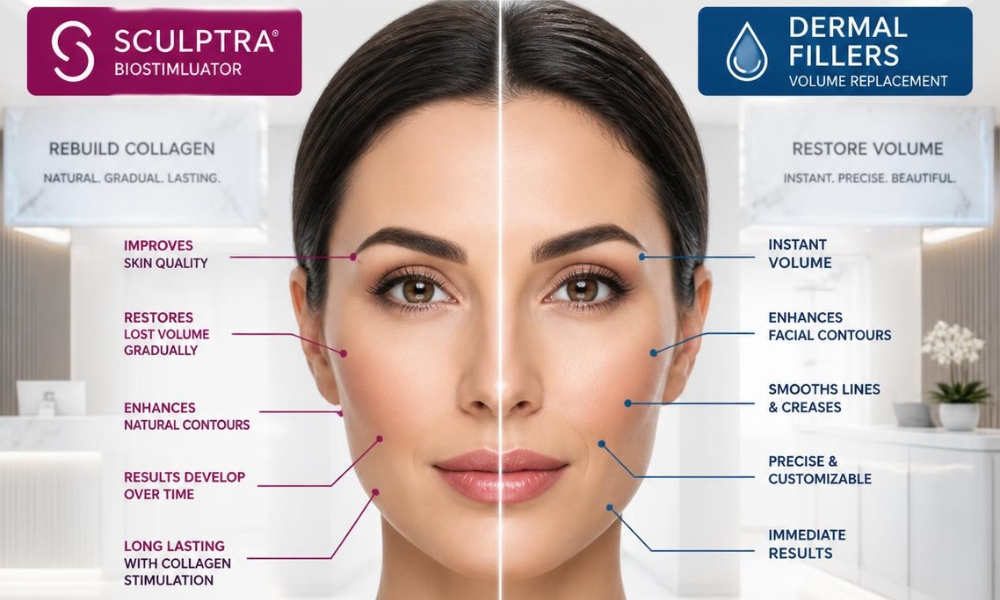
The honest answer is that neither treatment is automatically better for everyone. Traditional dermal fillers are designed to add volume or provide structural correction in specific areas, while Sculptra is a poly-L-lactic acid injectable that works gradually by stimulating collagen production. The right choice depends on what you are trying to change, how quickly you want to see results, your facial anatomy, and the treatment plan recommended by a qualified medical provider.
Understanding that difference is especially important if you’re noticing facial volume loss, flatter-looking cheeks, deeper folds, or changes in skin firmness. A treatment that works beautifully for one concern may not be the most appropriate option for another.
Table of Contents
- Sculptra vs Dermal Fillers: What’s the Short Answer?
- What Is Sculptra?
- What Are Dermal Fillers?
- How Are Sculptra and Dermal Fillers Different?
- Which Treatment Is Better for Facial Volume Loss?
- How Quickly Do Sculptra and Dermal Fillers Work?
- How Long Do Sculptra and Dermal Fillers Last?
- Which Treatment Looks More Natural?
- Who May Be a Good Candidate?
- Are Sculptra and Dermal Fillers Safe?
- Sculptra and Dermal Fillers in Katy, TX
- Frequently Asked Questions
- Medical Disclaimer
Important Note
Facial aging does not happen in exactly the same way for everyone. Some people mainly notice lost volume, while others are more concerned about skin quality, fine lines, or gradual changes in facial structure. Dermal fillers and Sculptra address different aspects of facial aging, so choosing between them should begin with understanding what has actually changed—not simply choosing the treatment that is most popular.
Sculptra vs Dermal Fillers: What’s the Short Answer?
Sculptra may be a better option when the goal is gradual collagen stimulation and broader improvement in facial structure and skin quality, while traditional dermal fillers may be better when a specific area needs immediate volume, contouring, or correction.
That distinction is the simplest way to understand the difference.
Sculptra contains poly-L-lactic acid, or PLLA. Rather than functioning primarily as a conventional volumizing gel, it works gradually by stimulating the body’s collagen response. The FDA-approved labeling includes correction of facial wrinkles and contour deficiencies, including fine lines and wrinkles in the cheek region.
Most commonly used hyaluronic acid dermal fillers, on the other hand, provide volume directly at the treatment site. Depending on the specific product and area, fillers can be used to address concerns such as facial folds, contour deficiencies, and lip or cheek volume. For example, certain JUVÉDERM products are FDA-approved for lip augmentation in adults over 21.
So if you are asking, “Should I get Sculptra or filler?” the better question is often, “What problem am I trying to solve?”
If you want a noticeable change in a particular area relatively quickly, a traditional filler may be considered. If you want a gradual change associated with collagen stimulation and overall facial rejuvenation, Sculptra may be considered.
In some treatment plans, the two approaches may even complement one another. However, combining injectable treatments should only be considered after an individualized assessment by a qualified provider.
What Is Sculptra?
Sculptra is an injectable treatment made with poly-L-lactic acid, a biodegradable synthetic material. It is commonly described as a collagen stimulator because its primary aesthetic effect develops gradually as the body produces new collagen in response to treatment.
This is an important difference from the way many people think about traditional fillers. Sculptra isn’t simply a gel being placed into a wrinkle to immediately fill a depression. Instead, the treatment is intended to encourage a gradual improvement in the underlying facial structure and skin appearance.
The FDA’s current labeling describes Sculptra as being indicated for correction of certain facial wrinkles and contour deficiencies, including fine lines and wrinkles in the cheek region in appropriate adults.
Because the effect develops gradually, Sculptra is generally not the treatment someone chooses when they want an immediate, precise correction of a small area. It is more of a long-term rejuvenation approach.
This gradual process can appeal to patients who want changes that develop subtly rather than appearing as an obvious overnight transformation.
How Does Sculptra Stimulate Collagen?
After Sculptra is injected into the appropriate treatment area, the poly-L-lactic acid particles interact with the tissue and stimulate a collagen-producing response. Over time, the treatment can contribute to improvements in facial structure, firmness, and the appearance of wrinkles.
The important word here is gradually.
Patients should not expect the immediate post-treatment appearance to represent the final result. Sculptra’s benefits develop over time, and a treatment plan may involve multiple sessions rather than one single appointment. The manufacturer’s current patient information describes a typical regimen of several injections over a period of months, although individual treatment plans vary.
This gradual nature is one of the biggest advantages for people who prefer a more progressive approach to facial rejuvenation.
What Are Dermal Fillers?
Dermal fillers are injectable products used to restore or add volume, soften certain facial lines and folds, and improve facial contours. There are several categories of fillers, and they are not interchangeable.
Hyaluronic acid fillers are among the most commonly used types in aesthetic medicine. Hyaluronic acid is a substance naturally found in the body and has the ability to attract and retain water. Different formulations are engineered to behave differently depending on where they are injected and what type of correction is needed.
For example, a softer filler may be appropriate when subtle movement and flexibility are important, while a firmer product may be selected when structural support or contouring is the primary goal.
This versatility is one reason dermal fillers are frequently used for facial rejuvenation. Depending on the product, treatment area, and patient’s anatomy, a provider can address a very specific concern rather than treating the entire face in the same way.
At Luminous MediSpa, patients can learn more about available options through the Dermal Filler & Injectables service.

How Are Sculptra and Dermal Fillers Different?
Although both treatments are injectable options used in facial rejuvenation, their mechanisms, treatment goals, and timelines can be quite different.
| Feature | Sculptra | Traditional Dermal Fillers |
|---|---|---|
| Main material | Poly-L-lactic acid | Varies by product; many are hyaluronic acid-based |
| Primary concept | Gradual collagen stimulation | Direct volume or structural correction |
| Results | Develop gradually | Often visible soon after treatment, with swelling settling afterward |
| Treatment approach | Usually planned as a series of treatments | Can often target a specific area during an individual treatment |
| Best suited to | Gradual facial rejuvenation and collagen-related concerns | Specific volume, contour, or wrinkle concerns |
This comparison is intentionally broad because “dermal filler” describes a large family of products. A provider must consider the specific filler, treatment area, and patient’s anatomy before deciding which approach is appropriate.
Which Treatment Is Better for Facial Volume Loss?
Facial volume loss is one of the most noticeable changes associated with aging. Cheeks can gradually appear flatter, temples may look less full, and the transition between different areas of the face can become more pronounced.
Both Sculptra and dermal fillers may play a role in facial rejuvenation, but they approach volume loss differently.
Traditional dermal fillers can provide direct volume and contouring in selected areas. This makes them useful when a provider needs to make a relatively precise correction. For example, a particular cheek area may require structural support, or a specific fold may benefit from carefully placed filler.
Sculptra takes a more gradual approach. Instead of simply placing volume where it is missing, it works through collagen stimulation. The result is intended to develop progressively, which can be useful when the overall concern involves gradual changes in facial structure and skin quality.
Neither approach should be viewed as a universal solution for facial aging. Sometimes the visible concern isn’t caused by volume loss alone. Skin laxity, collagen loss, changes in fat distribution, bone structure, and muscle activity can all contribute to how the face changes over time.
That is why a good consultation starts with assessment rather than immediately selecting a product.
How Quickly Do Sculptra and Dermal Fillers Work?
If immediate results are your highest priority, this is one of the most important differences to understand.
Traditional dermal fillers can produce visible volume immediately after injection. However, the initial appearance can be affected by temporary swelling, so the early result should not automatically be considered the final result.
Sculptra is different. Its intended effect develops gradually as collagen production increases. The manufacturer describes Sculptra as a treatment that gradually restores facial structure and volume associated with collagen loss.
This means someone who wants to look noticeably different for an event within a very short period may have different priorities from someone who is comfortable waiting for a gradual transformation.
The timeline should always be discussed before treatment so expectations match what the product is actually designed to do.
How Long Do Sculptra and Dermal Fillers Last?
Longevity depends heavily on the specific product, treatment area, amount used, individual metabolism, facial movement, and other patient-specific factors.
Sculptra is designed as a longer-term collagen-stimulating treatment. The manufacturer’s current information states that its results may last up to two years, although individual outcomes vary and clinical results should not be interpreted as a guarantee for every patient.
Dermal filler longevity varies considerably because different fillers are formulated for different purposes. Some may last several months, while others can provide correction for a year or longer depending on the product and treatment area.
Rather than choosing a treatment solely because it is advertised as “long-lasting,” it’s more useful to consider whether its mechanism and expected duration fit your goals.
For someone who values gradual collagen stimulation, Sculptra may be appealing. For someone who wants a specific area corrected with direct volume, a dermal filler may make more sense.
Which Treatment Looks More Natural?
Both Sculptra and dermal fillers can produce natural-looking results when appropriately selected and administered by a qualified, experienced medical professional.
The idea that one treatment automatically looks “natural” while the other looks artificial is misleading. A natural result depends on factors such as treatment planning, product selection, injection technique, facial anatomy, and how much correction is actually needed.
Sculptra’s gradual progression can appeal to patients who want a less immediate change. Because the improvement develops over time, the transition can be subtle.
Dermal fillers can also look very natural when used conservatively and strategically. In fact, the ability to place filler precisely can be valuable when a patient has one clearly defined area that needs correction.
The goal should never be to make your face look like someone else’s. Good aesthetic treatment works with your existing features and aims for proportion, balance, and a refreshed appearance.
Who May Be a Good Candidate for Sculptra or Dermal Fillers?
There is no single age or facial feature that automatically determines whether someone should receive Sculptra or dermal fillers. Candidacy depends on individual health, anatomy, expectations, and the specific concern being treated.
A person considering Sculptra may be interested in gradual improvement related to facial aging, collagen loss, wrinkles, or changes in cheek structure.
A person considering dermal fillers may have a more localized concern involving volume loss, facial folds, contour, or another area for which a particular filler is appropriate.
During consultation, your provider should review your medical history and examine the treatment area before recommending an injectable treatment. Certain medical conditions, active infections, allergies to product ingredients, or other circumstances may affect whether treatment is appropriate.
Realistic expectations also matter. Neither treatment can stop the natural aging process, and neither should be presented as a substitute for healthy skin care or medical treatment when a separate medical concern is present.
Are Sculptra and Dermal Fillers Safe?
Both Sculptra and dermal fillers have established medical uses, but injectable aesthetic treatments are not completely risk-free.
Common temporary reactions can include redness, swelling, tenderness, bruising, or discomfort at injection sites. Sculptra also has specific risks and injection requirements that make appropriate provider training particularly important. The FDA labeling notes that Sculptra should be used by healthcare practitioners trained in its indicated injection technique and includes warnings and precautions specific to the product.
Dermal fillers also carry potential complications, including uncommon but serious vascular complications. Because facial blood vessels and tissues are complex, injections should be performed by an appropriately qualified medical professional who understands facial anatomy and the specific product being used.
If you experience severe or unusual symptoms after an injectable treatment, contact your healthcare provider promptly rather than attempting to diagnose or treat the problem yourself.
Important Note
It is understandable to feel uncertain when comparing injectable treatments. Sculptra and dermal fillers are not simply two versions of the same procedure. They work differently and can be chosen for different aesthetic goals. A gradual collagen-building treatment may make sense for one person, while a precisely placed filler may be more appropriate for another. A professional assessment is the safest way to determine which approach fits your facial anatomy and expectations.
What Is the Difference Between Adding Volume and Stimulating Collagen?
One of the easiest ways to understand the difference between Sculptra and traditional dermal fillers is to think about what happens beneath the skin after treatment.
With many traditional fillers, the product itself provides volume. The provider places the filler into a specific area, and that added volume can help restore contours, soften certain facial lines, or improve proportions.
Sculptra takes a different route. Its primary purpose is to stimulate the body’s collagen response. Instead of relying mainly on the injected material to create immediate volume, the treatment encourages gradual changes in the treated tissue.
This distinction matters because it changes the entire treatment experience. A patient receiving traditional filler may notice an immediate difference, although swelling can temporarily affect the appearance. A patient receiving Sculptra needs to understand that the desired improvement develops progressively.
Neither approach is inherently superior. They simply solve different problems in different ways.
Which Is Better for Cheek Volume?
The cheeks are one of the areas where both Sculptra and dermal fillers may be considered for facial rejuvenation, but the treatment goals can be quite different.
If the primary concern is a specific loss of cheek projection or definition, a traditional dermal filler may provide the precision needed to restore volume in a particular location. The provider can evaluate the cheek structure and determine where additional support may improve facial balance.
Sculptra may be considered when the goal is a more gradual improvement associated with collagen stimulation and restoration of facial structure. Rather than creating a sharply defined contour immediately, the treatment is intended to produce a progressive change.
This distinction can be especially relevant for patients who don’t want an obvious cosmetic transformation. Some people prefer the idea of gradual improvement that develops over several weeks or months.
However, cheek treatment should always be individualized. The ideal placement and product depend on your existing facial structure, skin quality, degree of volume loss, and aesthetic goals.
Can Sculptra Replace Dermal Fillers?
Not always.
Although both treatments can contribute to facial rejuvenation, Sculptra and traditional fillers have different properties. Sculptra isn’t designed to replace every function of a conventional dermal filler.
For example, if a patient needs a precise amount of volume in a particular area, a traditional filler may offer greater control for that specific correction. If the goal is gradual collagen stimulation and broader facial rejuvenation, Sculptra may be considered instead.
Some patients may benefit from a treatment strategy that uses different approaches at different times. However, combining or sequencing injectable treatments requires careful planning. More treatment does not automatically mean better results.
A qualified provider should determine whether combining treatments is appropriate based on your facial anatomy and treatment goals.
Can Sculptra and Dermal Fillers Be Used Together?
In some patients, Sculptra and traditional dermal fillers may be used as complementary treatments rather than competing options. The reasoning is straightforward: one can provide direct volume or structural correction, while the other focuses on gradual collagen stimulation.
For example, a treatment plan may address a specific area with a conventional filler while using a collagen-stimulating approach for broader facial rejuvenation. Whether this makes sense depends entirely on the patient.
There is no universal combination that every patient needs. An experienced injector should first determine which concerns are actually present and then decide whether one treatment is sufficient.
It is also important to understand that combining treatments can affect cost, recovery, and the overall treatment timeline. A personalized plan should explain why each treatment is being recommended rather than simply adding procedures together.
What Does Sculptra Treatment Feel Like?
Patients often want to know what the actual treatment experience is like before deciding whether Sculptra is right for them.
The treatment involves a series of injections into the appropriate facial areas. The exact experience varies depending on the treatment area, individual sensitivity, and techniques used by the provider.
Some temporary redness, swelling, tenderness, or bruising can occur afterward. Your provider will give specific instructions about what to expect during recovery and how to care for the treated areas.
One important difference is that the treatment should not be judged solely by what you see immediately afterward. The desired collagen-related changes develop gradually, so the early appearance is not necessarily representative of the final outcome.
What Is Recovery Like After Dermal Fillers?
Recovery depends on the type of filler, treatment location, injection technique, and individual response. Many patients experience temporary swelling, redness, tenderness, or bruising around the injection sites.
Because traditional fillers can produce immediate volume, patients may notice a change in appearance right away. However, temporary swelling can make the initial result look different from the eventual outcome.
Your provider may recommend avoiding certain activities for a period after treatment. The exact instructions should come directly from your medical provider because aftercare varies by procedure and patient.
One of the most important things you can do after treatment is avoid making assumptions based on the first few hours. Allowing the treatment area time to settle can provide a much clearer picture of the result.
How Much Does Sculptra Cost Compared With Dermal Fillers?
Cost is naturally part of the decision when comparing Sculptra vs dermal fillers, but there is no single price that applies to every patient.
The total cost can depend on the product, number of treatment sessions, amount needed, treatment area, provider experience, and complexity of the treatment plan.
Sculptra may involve a series of appointments rather than a single treatment, so comparing the price of one Sculptra session with one syringe of dermal filler may not provide a meaningful comparison.
Likewise, the amount of dermal filler required can vary considerably between patients. Someone seeking a subtle correction may require less product than someone addressing significant volume loss.
The most useful approach is to discuss the complete treatment plan during a consultation. Ask what is being recommended, why it is appropriate for your concerns, how many sessions may be expected, and what ongoing maintenance could involve.
This gives you a clearer understanding of the overall investment rather than focusing only on the price of an individual syringe or appointment.
What Questions Should You Ask Before Choosing Sculptra or Fillers?
A consultation should be a conversation, not simply a sales pitch. If you’re uncertain about which treatment is right for you, asking specific questions can help you understand the recommendation.
- What is causing the facial change I am concerned about?
- Would Sculptra or a traditional dermal filler address that concern better?
- What results should I realistically expect?
- How quickly should I expect to see changes?
- How many treatment sessions might I need?
- How long might the results last?
- What are the potential side effects and complications?
- What will recovery involve?
- Would another treatment be more appropriate?
- What happens if I decide I don’t want additional treatment later?
These questions help shift the conversation away from simply asking which treatment is more popular and toward choosing the option that actually fits your needs.
Why Facial Anatomy Matters More Than a Trend
Social media can make aesthetic treatments look surprisingly simple. A before-and-after photograph may suggest that one product created a particular result, but a photograph cannot show everything that influenced the outcome.
Facial proportions, bone structure, skin thickness, fat distribution, muscle activity, age, and previous treatments all affect how an injectable treatment looks.
For this reason, copying someone else’s treatment plan is rarely a good approach. A filler that worked beautifully for one person’s cheeks may not be appropriate for another person’s facial structure.
The same principle applies to Sculptra. A collagen-stimulating treatment should be selected because it fits the patient’s concerns and anatomy—not simply because the treatment is trending online.
The best aesthetic results generally come from individualized planning rather than following a template.
What Happens During a Sculptra Consultation?
A thorough consultation gives your provider an opportunity to understand what bothers you and why. Instead of looking only at individual wrinkles, the provider may evaluate your face as a whole.
You may discuss changes you’ve noticed over time, such as flatter cheeks, reduced fullness, deeper folds, or an overall loss of facial firmness.
Your provider should also review relevant medical information and previous cosmetic treatments. This is important because previous injectables can affect how new treatments should be planned.
Photos may be taken to help evaluate changes over time and document your baseline appearance.
Once the assessment is complete, your provider can explain whether Sculptra, a traditional dermal filler, another aesthetic treatment, or no injectable treatment is appropriate.
What Happens During a Dermal Filler Consultation?
The process is similar, but the conversation may focus more heavily on the specific area you want to change.
If you’re concerned about facial volume loss, your provider may assess your cheeks, temples, chin, jawline, or other relevant areas. If your concern is a specific line or contour issue, the provider can determine whether filler is an appropriate treatment.
Product selection is particularly important because different fillers have different properties. A filler designed for one facial area may not be the best choice for another.
Your provider should explain the expected result, possible risks, recovery, and maintenance requirements before treatment begins.
Sculptra and Dermal Fillers in Katy, TX
If you are considering Sculptra Katy TX or dermal fillers Katy, choosing a medical practice that takes time to understand your facial structure and treatment goals is an important part of the process.
Luminous MediSpa in Katy provides aesthetic and skin rejuvenation services under the direction of Dr. Humera Naqvi, MD, a board-certified physician. The practice offers dermal filler and injectable treatments as part of its broader range of facial rejuvenation services.
During a consultation, patients can discuss concerns such as facial volume loss, changes in cheek definition, wrinkles, or other signs of facial aging. The appropriate treatment depends on the concern being addressed, the patient’s anatomy, medical history, and desired outcome.
For patients interested in traditional injectables, Luminous MediSpa offers a dedicated dermal filler and injectables service. The practice also provides several specific filler options, including Juvéderm, Restylane, and Belotero.
Patients in Katy and surrounding communities, including Fulshear, Cinco Ranch, and West Houston, can schedule a consultation to discuss whether a collagen-stimulating treatment, traditional dermal filler, or another facial rejuvenation approach is appropriate for their goals.
How to Choose Between Sculptra and Dermal Fillers
When you’re comparing Sculptra vs dermal fillers, there isn’t a single answer that applies to every face.
Instead, consider the type of change you want to make.
If you want gradual collagen stimulation and broader facial rejuvenation, Sculptra may be worth discussing with your provider. It is designed to stimulate collagen and produce a gradual change rather than simply adding immediate volume.
If you want more targeted volume or contouring, traditional dermal fillers may offer the precision you’re looking for. Depending on the product, fillers can be used in areas such as the cheeks, lips, chin, or other facial regions for which the product is appropriate.
If you’re unsure, that’s exactly what a consultation is for. You don’t need to arrive knowing which injectable you want. In fact, it may be better to describe the change you’re hoping to see and allow a qualified provider to recommend the appropriate options.
For example, instead of saying, “I want Sculptra,” you might explain, “My cheeks look flatter than they used to, and I want my face to look refreshed without looking overfilled.”
That gives the provider much more useful information when developing a treatment plan.
Can Sculptra Help With Skin Quality?
Sculptra is primarily known for its collagen-stimulating effect rather than functioning as a conventional surface skin treatment. As collagen production changes over time, patients may notice improvements in the overall appearance and structure of treated areas.
However, Sculptra should not be thought of as a replacement for treatments specifically designed to address pigmentation, acne, sun damage, or other surface-level skin concerns.
For patients with several different concerns, a broader facial rejuvenation plan may involve more than one treatment category. For example, a provider might recommend an injectable treatment for volume loss while addressing skin texture separately.
This is another reason why identifying the actual source of a cosmetic concern is more useful than choosing a treatment based solely on its popularity.
What If You Have Both Volume Loss and Skin Changes?
This is extremely common. Facial aging rarely happens in isolation.
You may notice that your cheeks have become less full while your skin also feels less firm. At the same time, fine lines may have become more noticeable and facial contours may have changed.
When several changes happen together, treating only one feature may not produce the result you expect.
A comprehensive assessment can help determine which concerns are related to volume loss, which are related to skin quality, and which may be caused by other changes in facial structure.
Depending on your needs, a provider may recommend one treatment first and reassess the result before deciding whether anything else is necessary.
This staged approach can be useful because it avoids automatically doing too much at once.
Important Note
Seeing facial changes does not mean you need an injectable treatment. Some changes are normal parts of aging, and not every wrinkle or loss of fullness requires correction. If you’re feeling overwhelmed by the number of cosmetic options available, start with the concern that bothers you most and discuss it with a qualified medical provider. A thoughtful recommendation should explain both what a treatment can do and what it cannot do.
What Results Should You Expect From Sculptra?
Sculptra results are gradual, which means patience is an important part of the treatment process.
Rather than expecting an immediate transformation, patients should understand that the treatment is intended to stimulate collagen and produce progressive changes. The FDA-approved product information and manufacturer materials emphasize the gradual nature of Sculptra’s results.
The exact degree of improvement varies from person to person. Factors such as age, skin condition, baseline collagen levels, treatment area, number of sessions, and individual response can influence the outcome.
Some patients may appreciate this slower progression because they prefer changes that are not immediately obvious to others.
It is important, however, not to judge the treatment too early. A gradual collagen-stimulating treatment requires time for the intended biological response to develop.
What Results Should You Expect From Dermal Fillers?
Dermal fillers can provide a more immediate change because the product itself contributes volume or structural support at the treatment site.
That does not mean the first appearance is necessarily the final result. Temporary swelling or tenderness can affect the treated area during the early recovery period.
Once the area settles, the provider can better assess the result and determine whether the treatment achieved the intended correction.
Depending on the product and area treated, dermal fillers may be used to restore facial volume, soften certain folds, or improve contours. Different products are formulated for different purposes, so your provider’s product selection is an important part of the treatment.
Which Treatment Is Better for Wrinkles?
The answer depends on what is causing the wrinkles.
Wrinkles can result from several factors, including repeated facial muscle movement, collagen loss, reduced skin elasticity, changes in facial volume, and sun exposure.
Because these causes are different, one injectable treatment cannot appropriately address every type of wrinkle.
Sculptra may be considered when collagen loss and gradual facial volume changes are contributing to the appearance of aging. Dermal fillers may be considered when a specific fold or volume deficiency can be addressed through carefully placed product.
Other treatments, such as neurotoxins, may be more appropriate for certain dynamic wrinkles caused by muscle activity. Luminous MediSpa offers neurotoxin treatments as another category of facial aesthetic care.
The key is matching the treatment to the cause rather than assuming every wrinkle needs filler.
Can Sculptra or Fillers Prevent Aging?
No cosmetic injectable can stop the natural aging process.
Sculptra and dermal fillers can address certain visible changes associated with aging, but they do not prevent future changes in skin, facial structure, or collagen production.
Think of these treatments as tools for managing specific aesthetic concerns rather than ways to permanently stop aging.
Sun protection, appropriate skin care, healthy lifestyle habits, and regular medical care remain important parts of maintaining overall skin and health. Cosmetic treatments can complement those habits but do not replace them.
Frequently Asked Questions About Sculptra vs Dermal Fillers
Is Sculptra better than dermal fillers?
Neither treatment is universally better. Sculptra focuses on gradual collagen stimulation, while traditional dermal fillers can provide more direct volume and targeted correction. The better option depends on your facial concerns and treatment goals.
What is the main difference between Sculptra and fillers?
Sculptra is a poly-L-lactic acid collagen stimulator that works gradually. Many traditional dermal fillers, particularly hyaluronic acid fillers, provide volume more directly at the treatment site.
Does Sculptra give immediate results?
No. Sculptra’s intended results develop gradually as collagen production increases. The appearance immediately after treatment should not be considered the final result.
Do dermal fillers work immediately?
Many dermal fillers provide visible volume soon after treatment, although swelling and other temporary effects can make the early appearance different from the eventual result.
How long does Sculptra last?
Sculptra’s manufacturer states that results may last up to two years, although individual results vary.
How long do dermal fillers last?
Longevity varies significantly depending on the filler, treatment area, amount used, and individual factors. Some fillers last several months, while others may last a year or longer.
Is Sculptra good for facial volume loss?
Sculptra may be appropriate for some patients experiencing facial volume changes associated with collagen loss. A consultation is needed to determine whether it is suitable for your specific type and location of volume loss.
Can Sculptra and dermal fillers be used together?
In some cases, a qualified provider may recommend both treatments as part of a personalized facial rejuvenation plan. They work differently, so combining them should be based on individual anatomy and treatment goals.
Which is better for natural-looking results, Sculptra or filler?
Both can produce natural-looking results when appropriately selected and administered. Natural results depend heavily on treatment planning, product selection, injection technique, and avoiding unnecessary correction.
Is Sculptra considered a dermal filler?
Sculptra is an injectable aesthetic treatment and is sometimes grouped broadly with dermal fillers, but it works differently from traditional volumizing fillers. It is primarily classified as a poly-L-lactic acid collagen stimulator.
Is Sculptra painful?
Patients may experience temporary discomfort during injections. The exact experience varies based on individual sensitivity, treatment area, and the techniques used by the provider.
What should I choose if I want immediate facial volume?
If immediate volume is your primary goal, a traditional dermal filler may be more appropriate to discuss with your provider. The specific filler and treatment area still need to be evaluated individually.
What should I choose if I want gradual facial rejuvenation?
Sculptra may be worth discussing if your goal is gradual improvement associated with collagen stimulation. Your provider can determine whether it is appropriate based on your facial structure and concerns.
Final Thoughts: Sculptra or Dermal Fillers?
The choice between Sculptra vs dermal fillers comes down to what you want to accomplish.
Sculptra works gradually by stimulating collagen and may be appropriate for patients seeking progressive facial rejuvenation and improvement associated with collagen loss. Traditional dermal fillers can provide more direct volume and precise correction for selected facial concerns.
Neither treatment should be selected simply because it is considered the latest trend or because someone else achieved a result you like. Your facial anatomy, skin condition, medical history, treatment goals, and expectations all matter.
If you are experiencing facial volume loss and aren’t sure whether a collagen stimulator or traditional filler is right for you, a professional consultation is a sensible starting point. You can explain what has changed, what you would like to improve, and how subtle or noticeable you want the result to be.
From there, a qualified provider can help you understand the available options and decide whether treatment is appropriate.
Discuss Your Facial Rejuvenation Options
If you’re considering Sculptra or dermal fillers in Katy, TX, a consultation can help you understand which approach may fit your facial concerns and desired outcome.
Luminous MediSpa offers injectable and facial rejuvenation services with treatment planning based on individual patient needs.
Medical Disclaimer
This article is provided for general educational purposes and does not constitute medical advice, diagnosis, or treatment. Cosmetic injectable treatments have potential risks and may not be appropriate for everyone. A qualified healthcare professional should evaluate your medical history, anatomy, treatment goals, and individual circumstances before recommending an injectable treatment.